Gallery-wrapped, ready to hang
Stretched over a 38 mm (1.5 in) bar and delivered stretched — there is nothing to assemble and no separate frame to buy.
Sizes are matched to this artwork. Formats that aren’t its exact shape are centred and trimmed to fit — every size shows how much.
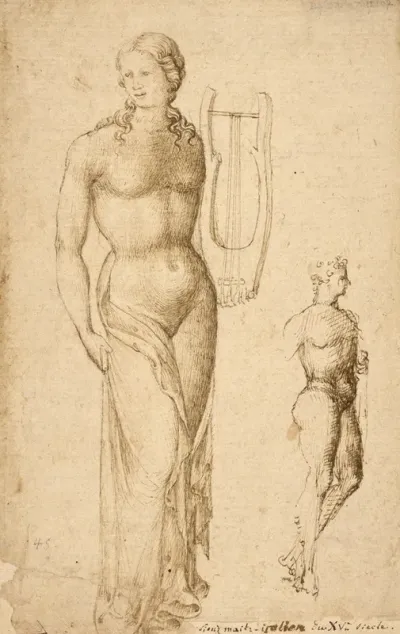
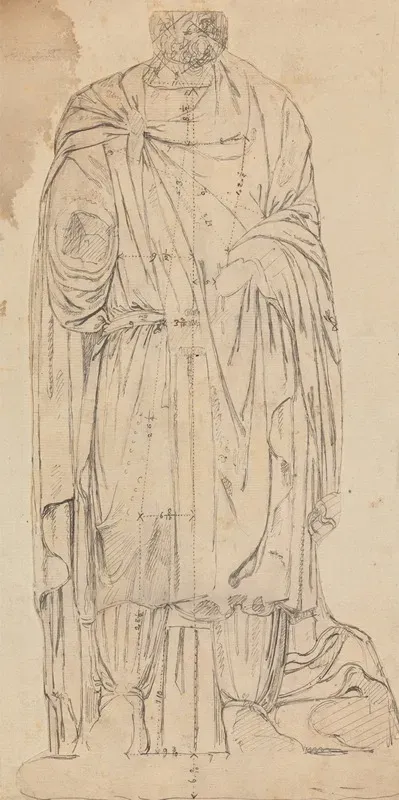
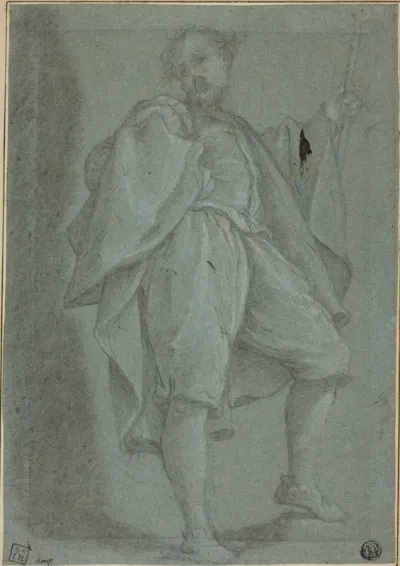
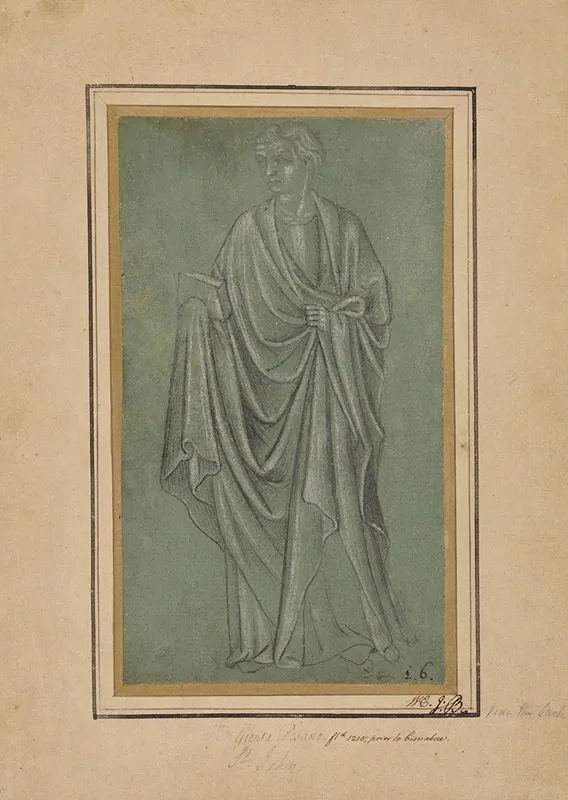
A Draped Figure Holding A Book is a public-domain artwork by Italian School, dated 1380. The artist is catalogued as Italian. The high-resolution file measures 3862 × 5436 px (15.1 MB). Catalogued under Drawings and Renaissance, in portrait format. Archive Lane holds 76 works by Italian School, an Italian artist.
Italian art has always enjoyed great popularity. Leonardo da Vinci, Michelangelo Buonarroti and Raphael da Urbino are among the most famous faces in art history. The origin of Italian art can be traced back above all to antiquity, whose reference remains recognizable over the centuries to this day. As a highly respected commodity, art in Italy was always promoted by politics and the church. Architecture also played an important role, as it often happened that famous artists were involved in the construction of large Italian cathedrals or churches. Iconic features were, among other things, the geometric design, magnificent paintings inside the buildings and domed roofs. In addition to the Christian faith, Italian art since the Middle Ages has also been influenced by other countries and their cultures. For example, by the Byzantine Empire, France and Germany, and also by some Islamic countries. The fabulous diversity that can be seen in the artistic landscape of Italy is undoubtedly the result of these influences, which run through the various periods of art history. The Renaissance, as one of the most important art epochs in Italy, is especially known for its three-dimensional works of art. The main themes here were beauty, harmony and perfection in the form of statues, based on ancient models. However, nudity as natural perfection was also captured on canvas in as much detail as possible. While cities such as Florence and Venice were of central importance for art during the Renaissance, the Baroque era took place primarily in Rome. Here, architecture and painting worked primarily with colors such as white and gold, as well as with powerful and lush forms. Ceiling painting as such reached its peak during the Baroque period and was of great importance for this epoch. In the classicism one finally broke away from the expansive style of the Baroque and recalled in the design rather the simplicity and elegance, which followed a strict symmetry. With Historicism, which to
A Draped Figure Holding A Book is free to preview at web resolution. The original high-resolution file is a one-time purchase, or included with an Archive Lane membership (up to 1,000 high-resolution downloads per day) — and the artwork can also be ordered as a made-to-order print.
View all artworks by Italian School→
| Artist | Italian School |
| Year | 1380 |
| Category | Drawings |
| Style | Renaissance |
| Color | Brown |
| Resolution | 3862x5436 |
| Orientation | Portrait |
| File Type | High-resolution JPG |
| Source | Public domain, restored by Archive Lane |
| License | Personal & commercial use, no attribution required |
| Delivery | Instant digital download; prints made to order and shipped locally |
| SKU | 320141 |
Instant digital delivery.Download the original high-resolution file immediately with your membership — no shipping, no waiting.
Prints.Every print is made to order at the production partner closest to you, then shipped directly. Typical delivery to the US is 5–11 business days depending on the material — framed pieces take the longest.
This public domain artwork is offered as an original high-resolution digital download.
Stretched over a 38 mm (1.5 in) bar and delivered stretched — there is nothing to assemble and no separate frame to buy.
The outer strip of the artwork is mirrored around the sides, so the full picture stays on the face of the canvas instead of disappearing around the corner.

A heavy 400 gsm canvas with a matte woven surface. There is no glass in front of it, so the print stays readable from any angle and in any light.
Every room view above is drawn to the real scale of the size you selected, measured against the furniture in the photograph — so the wall space is a fair estimate, not decoration.