Mirrored edge, nothing cropped
The outer strip of the artwork is mirrored around the sides, so the full picture stays on the face of the canvas instead of disappearing around the corner.

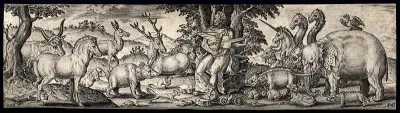
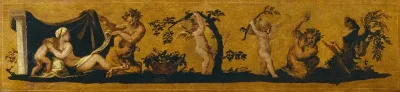
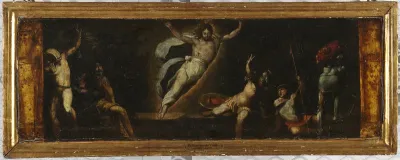
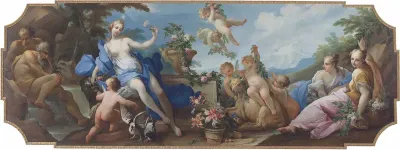
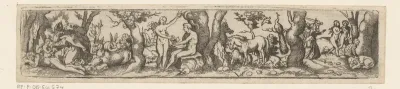
Cupids Pulling in a Net is a painting by Caravaggio (1571–1610) from 1527. The high-resolution file measures 2,000 × 384 pixels. Because the work is in the public domain, Archive Lane offers the full-resolution file for download and as a made-to-order print.
View all artworks by Caravaggio→
| Artist | Caravaggio |
| Year | 1527 |
| Medium | Painting |
| Origin | Wikimedia Commons |
| Category | Paintings |
| Style | Baroque |
| Resolution | 2000x384 |
| Orientation | Landscape |
| File Type | High-resolution JPG |
| Source | Public domain, restored by Archive Lane |
| License | Personal & commercial use, no attribution required |
| Delivery | Instant digital download |
| SKU | 943152 |
Instant digital delivery.Download the original high-resolution file immediately with your membership — no shipping, no waiting.
The outer strip of the artwork is mirrored around the sides, so the full picture stays on the face of the canvas instead of disappearing around the corner.

A heavy 400 gsm canvas with a matte woven surface. There is no glass in front of it, so the print stays readable from any angle and in any light.
Everything you need to know about your canvas before you order.
Cupids Pulling in a Net is a painting by Caravaggio (1571–1610), dated 1527. The artist is catalogued as Italian. The high-resolution file measures 2000 × 384 px (0.2 MB). You will find it among Paintings and Baroque, in landscape format. Archive Lane holds 160 works by Caravaggio, an Italian artist.
Michelangelo Merisi da Caravaggio, known mononymously as Caravaggio, was an Italian painter active in Rome for most of his artistic life. During the final four years of his life, he moved between Naples, Malta, and Sicily. His paintings have been characterized by art critics as combining a realistic observation of the human state, both physical and emotional, with a dramatic use of lighting, which had a formative influence on Baroque painting.