Mirrored edge, nothing cropped
The outer strip of the artwork is mirrored around the sides, so the full picture stays on the face of the canvas instead of disappearing around the corner.
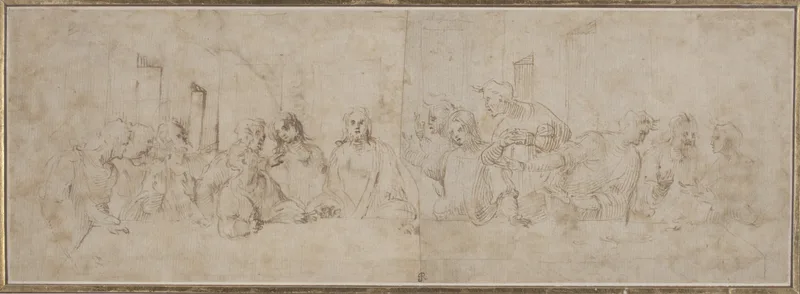
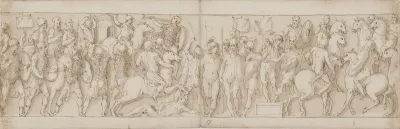
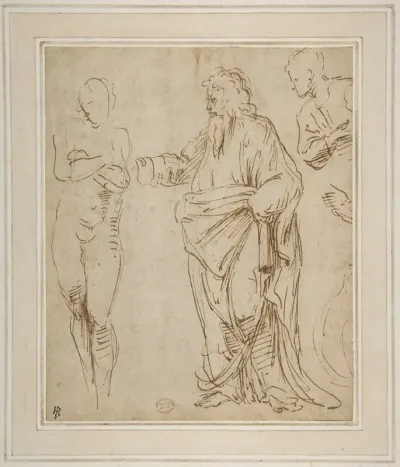
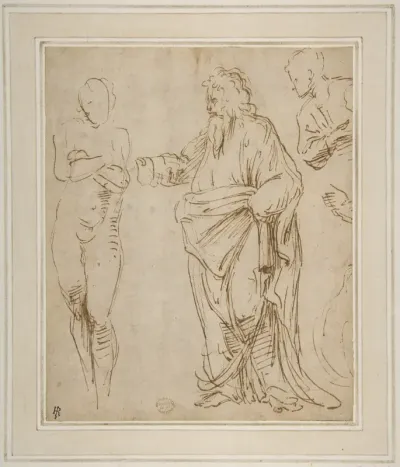
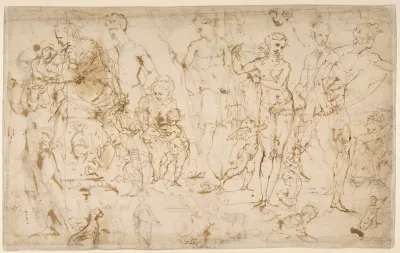
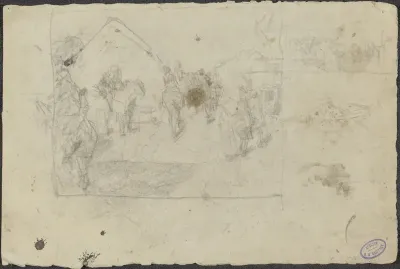
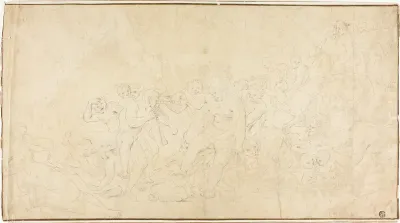
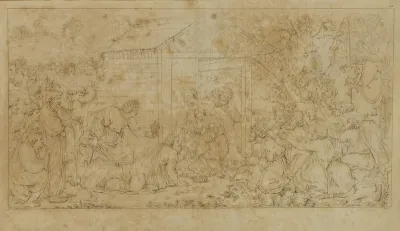
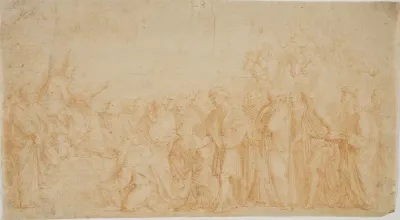
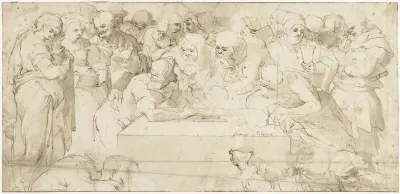
The Last Supper, a drawing by Vincenzo Tamagni (1512–1516), dated 1515. The source copy is at Wikimedia Commons; the file offered here is 4,000 × 1,471 pixels. It is filed under Drawings within Italian art. The work is in the public domain, so the full-resolution file can be downloaded and printed without licence restrictions.
View all artworks by Vincenzo Tamagni→
| Artist | Vincenzo Tamagni |
| Year | 1515 |
| Medium | Drawing |
| Origin | Wikimedia Commons |
| Category | Drawings |
| Resolution | 4000x1471 |
| Orientation | Landscape |
| File Type | High-resolution JPG |
| Source | Public domain, restored by Archive Lane |
| License | Personal & commercial use, no attribution required |
| Delivery | Instant digital download |
| SKU | 915170 |
Instant digital delivery.Download the original high-resolution file immediately with your membership — no shipping, no waiting.
The outer strip of the artwork is mirrored around the sides, so the full picture stays on the face of the canvas instead of disappearing around the corner.

A heavy 400 gsm canvas with a matte woven surface. There is no glass in front of it, so the print stays readable from any angle and in any light.
Everything you need to know about your canvas before you order.
The Last Supper is a drawing by Vincenzo Tamagni (1512–1516), dated 1515. The artist is catalogued as Italian. The high-resolution file measures 4000 × 1471 px (1.1 MB). Catalogued under Drawings, in landscape format. Archive Lane holds 12 works by Vincenzo Tamagni, an Italian artist.
Vincenzo Tamagni was an Italian painter of the Renaissance. Born in San Gimignano, he became an apprentice first with il Sodoma at Monte Oliveto Maggiore, and then worked in the Vatican Loggie under Raphael in Rome (1512-1516). Drawings of the Raphael frescoes in Tamagni's hand exist. He mainly painted in the towns surrounding Siena. He painted altarpieces for San Girolamo and Sant'Agostino in San Gimignano. He is featured in Giorgio Vasari's Vite, who refers to him as Vincenzo da San Gimignano.