Mirrored edge, nothing cropped
The outer strip of the artwork is mirrored around the sides, so the full picture stays on the face of the canvas instead of disappearing around the corner.
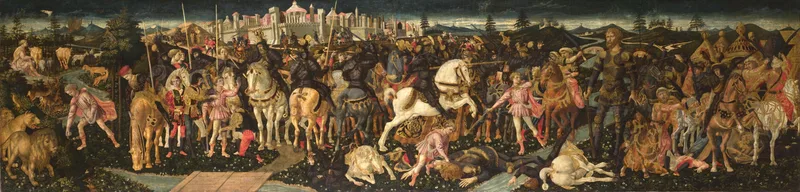
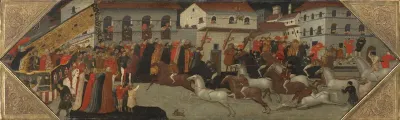
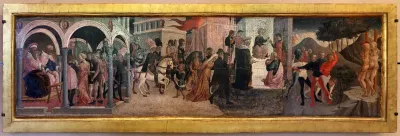
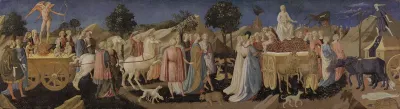
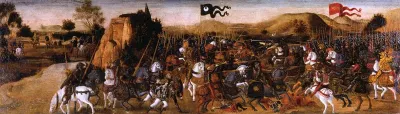
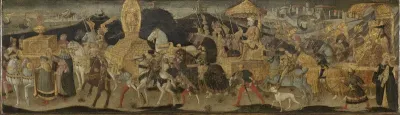
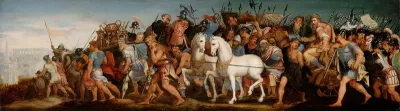
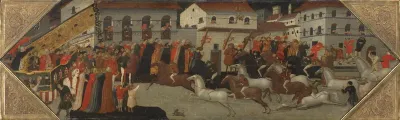
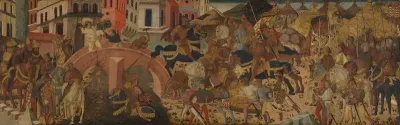
Francesco Pesellino (1367–1446) made The Story of David and Goliath, a painting, made in 1445. The high-resolution scan comes from Wikimedia Commons and measures 5,383 × 1,292 pixels. Catalogued under Paintings, it belongs to the Italian tradition. This is a public-domain work: free to preview, available in full resolution and as a print.
View all artworks by Francesco Pesellino→
| Artist | Francesco Pesellino |
| Year | 1445 |
| Medium | Painting |
| Origin | Wikimedia Commons |
| Category | Paintings |
| Style | Renaissance |
| Resolution | 5383x1292 |
| Orientation | Landscape |
| File Type | High-resolution JPG |
| Source | Public domain, restored by Archive Lane |
| License | Personal & commercial use, no attribution required |
| Delivery | Instant digital download |
| SKU | 941209 |
Instant digital delivery.Download the original high-resolution file immediately with your membership — no shipping, no waiting.
The outer strip of the artwork is mirrored around the sides, so the full picture stays on the face of the canvas instead of disappearing around the corner.

A heavy 400 gsm canvas with a matte woven surface. There is no glass in front of it, so the print stays readable from any angle and in any light.
The Story of David and Goliath is a painting by Francesco Pesellino (1367–1446), dated 1445. The artist is catalogued as Italian. The high-resolution file measures 5383 × 1292 px (2.3 MB). It is filed under Paintings and Renaissance, in landscape format. Archive Lane holds 16 works by Francesco Pesellino, an Italian artist.
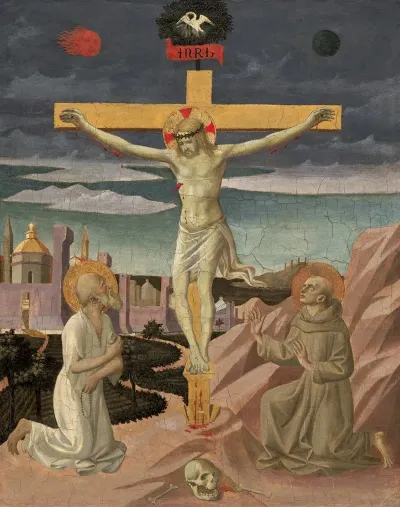
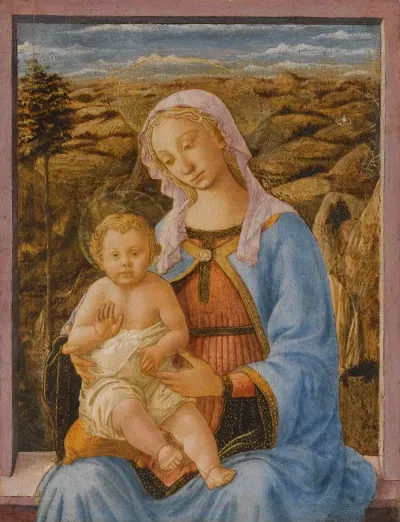
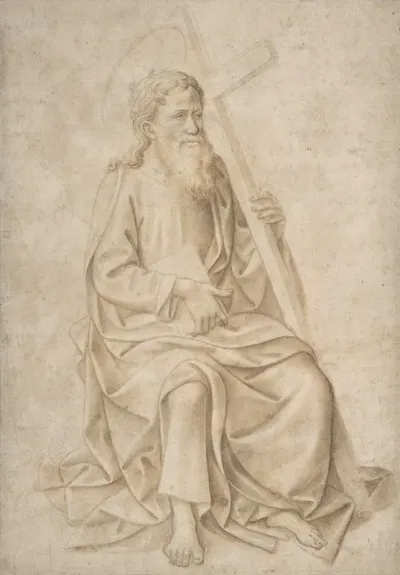
Francesco Pesellino, also known as Francesco di Stefano, was an Italian Renaissance painter active in Florence. His father was the painter Stefano di Francesco, and his maternal grandfather was the painter Giuliano Pesello (1367–1446), from whose name the diminutive nickname "Pesellino" arose. After the death of his father in 1427, the young Pesellino went to live with his grandfather whose pupil he became. Pesellino remained in his grandfather's studio until the latter's death, when he began to form working partnerships with other artists, such as Zanobi Strozzi and Fra Filippo Lippi. He married in 1442, and probably joined the Florentine painters' guild in 1447. In the following years he made for reputation with small, highly-finished works for domestic interiors, including religious panels for private devotional use and secular subjects for pieces of furniture.
Everything you need to know about your canvas before you order.